
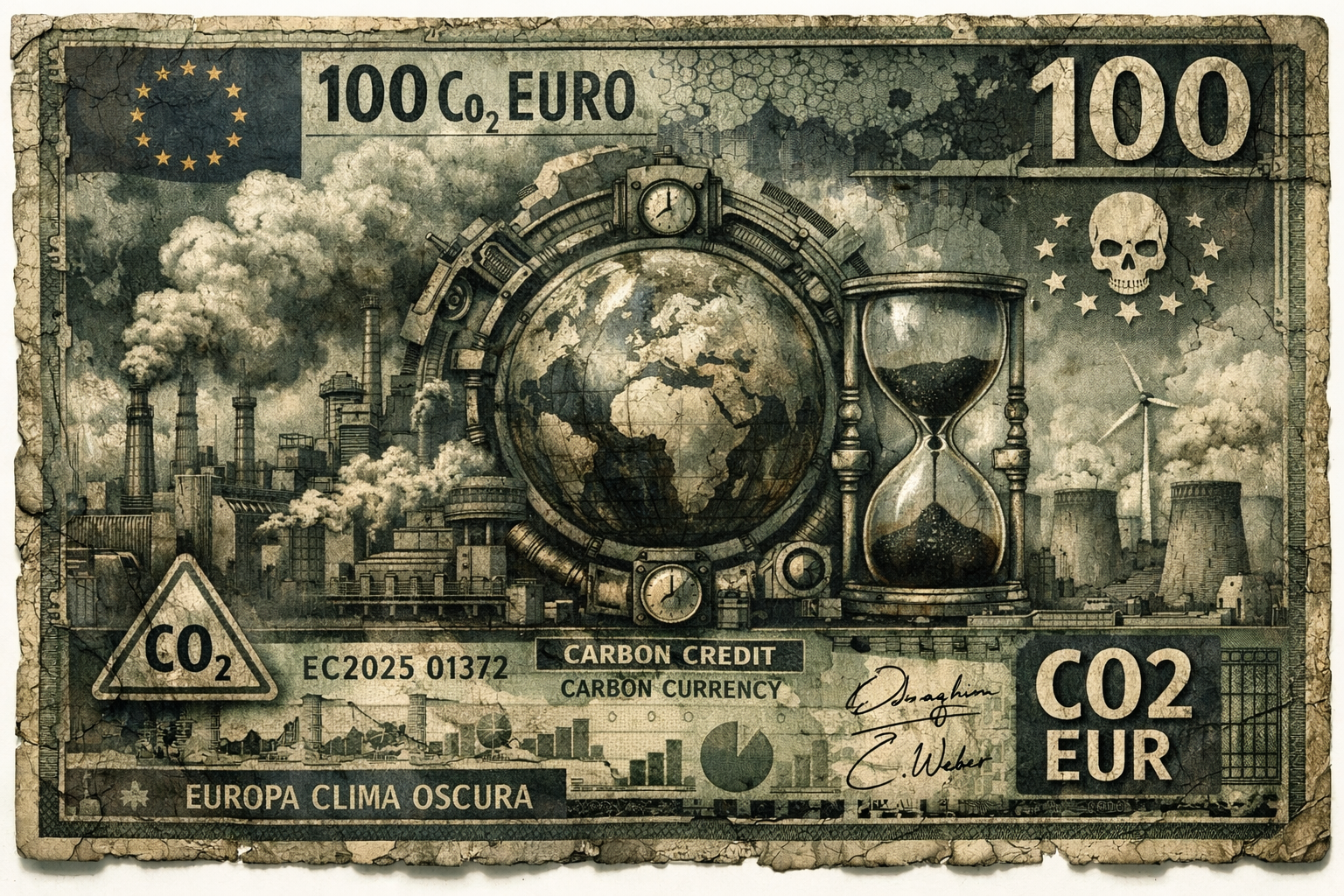
SOURCE: ESC
EU to extend carbon border levy to car parts, refrigerators, and washing machines.
That was today’s Reuters headline1. It may sound like boring bureaucratic noise, but it really isn’t. It is the final piece of a puzzle that has been coming together for three years. We usually hear about these things separately: a new ‘Digital Euro’, a new ‘Digital ID’, or a new ‘Carbon Tax’.
But when you look at the timeline, you realise they aren’t separate. They are gears in a single machine.
Right now, if you have the money to buy something, you can buy it. Your bank checks your financial balance, and that’s it. But by 2029, that changes2. The infrastructure is being built to check a second balance: your carbon balance.
Today’s news confirms that the system is expanding from taxing raw steel to taxing the things you actually buy — fridges, cars, and washing machines. The system will soon know exactly how much carbon is in your shopping cart, and for the first time, it will have the power to say ‘no’ at the checkout.
Here is how it works.
The Three Parts of the Trap
- The Scorecard: Digital Product Passports How does a checkout terminal know how much carbon is in a washing machine? Enter the Digital Product Passport3. Think of this as a digital birth certificate for objects. It will appear as a QR code on the box or a tiny chip inside the product. Scan it, and it reveals everything about the item — including exactly how much CO₂ was emitted to make it.This is already law. Battery Passports4 become mandatory in 2027.
- The ID: Your Digital Wallet To make this system work, the network needs to know who is buying the product. By 2026, every EU country must offer a Digital Identity Wallet5. By 2027, banks and large platforms must accept it. This isn’t just a digital driver’s license; it’s a container for your personal data ‘attributes’ — like your age, your address, or eventually, your carbon allowance.
- The Enforcer: The Digital Euro (CBDC) Most people think they already use ‘digital money’ when they tap their Visa card. But that money is just a digital IOU from a private bank. A Central Bank Digital Currency6 (CBDC) is different. It is issued directly by the European Central Bank. And unlike the money in your bank account today, this new money is designed to support ‘conditional payments’.It is money that can check if you obeyed the rules before the transaction goes through.
How It Works in Real Life
Central banks have already successfully tested this technology (see Project Rosalind7). They call it a ‘Three-Party Lock’.
It functions like a digital turnstile. To open it, three keys must turn at the same time:
- Identity: Who are you? (Checked by your Digital Wallet)
- Asset: What are you buying? (Checked by the QR code on the product)
- Permission: Do you have the allowance? (Checked by the system)
Here is what a shopping trip could look like in 2029:
Scenario A: The Washing Machine You tap your phone to buy a new washer. The terminal scans the Product Passport and sees it contains 142 kg of embedded CO₂ (roughly the same emissions as driving 350 miles). Your digital wallet checks your monthly carbon budget. You are over your limit.
- The Result: The payment fails, or a popup asks if you want to pay a ‘Carbon Surcharge’ of €50 to authorise the transaction.
Scenario B: The Flight You try to book a holiday flight. The airline’s system pings your wallet. It sees you’ve already taken two flights this year.
- The Result: The ‘Standard’ fare is grayed out. You can only purchase the ‘High-Emitter’ fare, which costs double.